The Break is Over (I think)

The last time I wrote a blog post, I was in the middle of finishing up my first novel, We Grow Immortal.

My first stand-alone novel.

I’ve tried to write post after post since then, but I ended up rambling for pages and I finally realized I was doing it for myself, not for anyone who might want to read about writing. I’ll do some catching up in bullet points, hopefully sticking to the things that really changed my writing habits.

  • I was revising my book.
  • My dad was diagnosed with pancreatic cancer. It was awful. He died and my soul was broken.
  • I published my book about a month after he passed, but it was hard to get back to writing.
  • About 8 months later, I finally started to do a little writing and then Covid happened. The chaos with my job as a teacher was … overwhelming, he said politely.
  • During all of the school/Covid struggles, I was diagnosed with Barrett’s esophagus, but not before it almost killed me.
  • I was sleeping for 15 minutes here and there and waking up over and over and over and over feeling like I was choking to death all night. I lost 30 pounds because eating with my throat feeling so closed up felt impossible.
  • My wife saved my life by making me go to all the doctors I needed to see.
  • I needed CT scans, MRIs, blood tests, an EGD, and other scopings. 
  • I was prescribed a change in diet, a special formulation of Prilosec, and countless other medications to address the stress put on my entire system. 
  • I eventually stopped taking almost all of the medications finally and while the issue isn’t solved, it’s become much more manageable.
  • I’m writing again. 

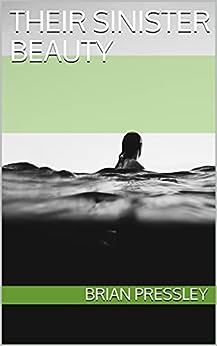
I know that with school starting back up in a few weeks that I might not be writing as much as I want, but the important thing is that I’m starting to WANT to write again. In the middle of all the mess listed above, I did publish another short story, Their Sinister Beauty, but it was something that I had mostly finished before things got too crazy with my dad, and looking back, it’s amazing to me that I managed to accomplish even that.

They wait in the sea.

In any case, I’m dusting off my notebooks, polishing up my fountain pens, reorganizing all of my computer files, and FINISHING things that I started what seems like a hundred years ago. I hope some of you will still have the time and interest to check out my new stories as they arrive, hopefully in the near future. 

How I Wrote a Novel – Advice for a specific delusion

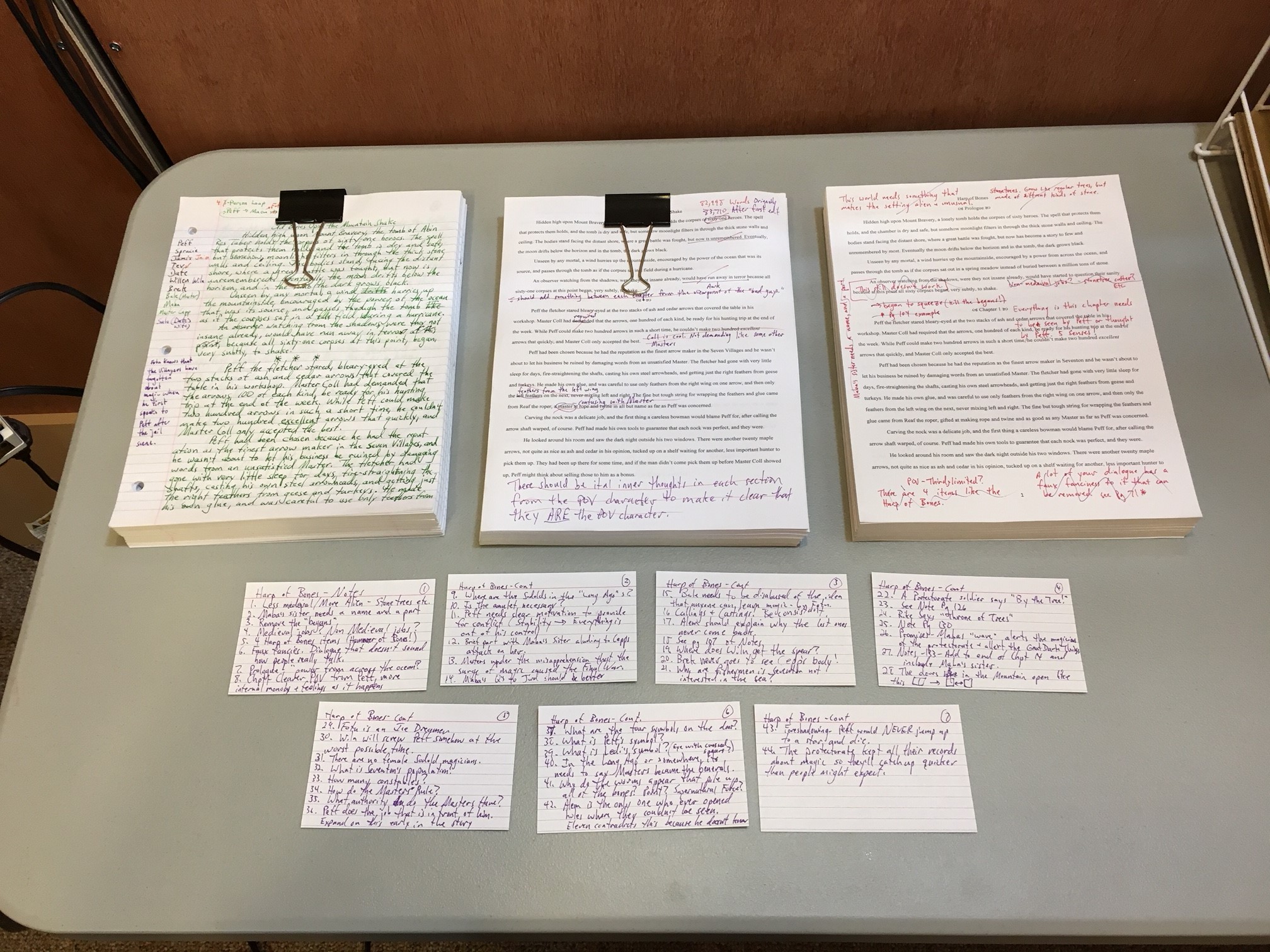
IMG_3624

There are over 800 pages in the top three piles.

I wish the Internet had existed when I dreamed of being a writer thirty years ago. Being restricted to textbooks about writing and rare interviews of my favorite authors, I didn’t get a very realistic view of what the long process of writing a novel looks like. I have yet to sign that million dollar deal with a publisher, but I have completed a fair amount of work, and do have some things published, so I’m throwing down a slightly mechanical look at the time needed and the process I used to get the job done. Will this work for you? I don’t know, but if nothing else it might get you looking for the tools that will make you successful.

  1. First, the big picture: I realized that most people who write how-to-write-a-novel books provide advice that is not really useful.
  2. I read everything I could by published authors who had managed to maintain success over a reasonably long period. When I say everything, I should clarify that I mean about writing as a job and about authors’ habits when it comes to writing. They all agree on one thing: nobody just sits down and writes a novel in one go. They all go back and rewrite, edit, proofread, edit some more, share with friends, make changes based on friends’ suggestions, punch friends who get too pushy, and ignore friends who are just plain wrong. But they go over their manuscripts multiple times, many of them spending more time rewriting than they did actually writing the first draft.
  3. I realized that you need to write all the time. This includes rewriting as well. Shut off your TV, smartphone, laptop, etc., and write whenever you can. If you can’t do that, try to limit your distraction time to an hour a day and write all the other time that you can. Literally. Set a timer for an hour, and when that time is up, shut off your device and go write. If you get distracted on your laptop when you’re writing, buy a notebook and some fountain pens, and go sit your ass in a chair somewhere away from all that stuff.
  4. Now, the actual novel picture: I read a poem, something I don’t often do, and that gave me an idea.
  5. I did some discovery writing, which is a fancy term for saying I did some writing before I knew what the story was going to be exactly, so I could figure out who my characters were and what things were like where they lived. THIS IS OKAY. I wish somebody had told me this was a thing you could do a long time ago. So many of those novel-writing books say to write an outline of your story or you can’t get going, but stories are big and complicated and confusing, and sometimes it’s helpful to write to get your feet under you before you really get down to the tricky parts, like “How is this all going to end?”
  6. I hand-wrote around 84,000 words. This took a while. Somewhere around 20,000 words I took some time to clarify the plot, setting, character motivation, ending of my story, and probably some other stuff, too.
  7. I transcribed this all to a word processor, using speech-recognition software, and did some light editing as I worked.
  8. Realized some adjustments were needed (there needed to be more background about the world I had created, which I did by adding another character who needed six chapters of his own, so I JUST WENT BACK AND PUT HIM IN LIKE A BOSS) and wrote around 24,000 additional words. This took a while.
  9. Printed the 109,000-ish-word document, proofread, and added editorial notes. This took a while. Every page probably had ten to twenty comments or proofing marks.
  10. I typed in all of my changes and printed the document again.
  11. Printed the still around 109,000-ish-word document, proofread, and added editorial notes. This took a while. Every page probably had five to ten comments or proofing marks.
  12. I typed in all of my changes.
  13. As I went through each time, I kept notes on index cards about large issues that needed to be addressed. I worked on those as well, but the last time there were still 44 issues that needed to be addressed to deal with issues of character development, continuity, foreshadowing, motives, point of view concerns, and some other things, I imagine.
  14. I actually sat down and read a physical copy of the manuscript specifically to see it just as a reader. This helped me find awkward parts that weren’t so obvious when I was looking for comma placement and grammar issues.
  15. I don’t know when I started writing, but the first rough draft that I typed up was finished on July 16th, and as of this writing it’s February 20th of the following year. I have a feeling that I might have started hand-writing during the February break last year.
  16. I’m still not really done. I need to address those 44 issues, but they are not all horrible, so I feel like I could be finished in another week or so.
  17. The next step is giving the final draft to my editor. When I get it back I will print it out, AGAIN, and will address her suggestions, see if anything else jumps out at me, and then I’ll publish it.
  18. One last big-picture thing: I already finished a novel that hasn’t been published, got it back from my editor, and have resubmitted it for her final approval. I did all the things listed above for that one as well. That was submitted originally last April. Could it be published before this April? I’m keeping my fingers crossed.

I just kept putting one word after the other and stole tools from authors that I thought would work for me. I’m not trying to be Shonda Rhimes, but she’s got some good advice. I’m not trying to be Brandon Sanderson, but he’s got some good advice. The Internet has made a million dollars’ worth of advice available with a few taps or clicks. Go steal it and then do something delusional.

Be Delusional

2018 Number fixed

     I’m going to give you a blessing for the new year. Maybe you need it and maybe you don’t, but I’m going to give it to you.
     I’m well aware that I have no authority over you and that I may mean almost nothing to you, but I’m going to give you this blessing anyway:

     If there’s something crazy that you want to do, you have my blessing to do so.

     I don’t particularly mean that you should go skydiving naked, unless that’s something that puts a tingle in your giblets. What I mean is that you should do something magical that the voices in your head have always held you back from doing.

     Go compose a song.

     Take a painting lesson.

     Write that novel.

     Post your poetry on Facebook if there’s no place else to put it.

     Take six hundred pictures of that weird bird that keeps attacking your garden hose and share them (okay, like ten of the good ones) with your friends.

     Make something that didn’t exist and ignore that son of a bitch in your head that makes you feel embarrassed about sharing it with other people. Make some art, make some music, make some poetry, and for fuck’s sake, blast it out across the whole universe and don’t feel weird about it at all.
     Because.
     Because out there somewhere is one person, or maybe ten thousand people, who will love what you did. Your art will speak to them. Your song will make them dance across the kitchen while they’re making toast. Your novel will make them realize that they’ve got a tale to tell and they’ll pick up a sexy fountain pen and write their story in notebooks and on napkins and on the backs of old envelopes, and then they’ll share right back at you.
     I see posts where people say dismissive and condescending things like “Every soccer mom who buys a camera thinks she’s a photographer.”
     Well, you know what?
     She is.
     And if people don’t think so? Tell them to go eat shit.
     Be ridiculous. Let that part of you that liked to color when you were five back out into the world. You don’t have to be so grown-up all the time. Life is too serious to not also be beautiful.
     Wouldn’t the world be more amazing if you went and did something delusional?

From Pratchett to Pressley

If there is a bright continuum of writers that contains both Terry Pratchett and Brian Pressley, then Terry Pratchett is a star in the family of the blue-white supergiants and Brian Pressley is something like an LED flashlight. That’s not meant to be an expression of false modesty on my part, either. Pratchett managed to produce over 50 novels and received dozens of awards, including a knighthood, and if I ever found myself within striking distance of a writing career like that I would probably explode. I think it’s fair to say that I’m at the beginning of a writing career that could go like that, but I understand that I would have to be driven nearly beyond reason and that the fates would have to be kind for me to continue along the path like the one he eventually followed.

I think that people often feel compelled to elevate their heroes or role models to godlike status after they die, but anyone familiar with all of Sir Terry’s books would have to concede that some of the early books don’t have the same polished feel as most of the newer books. Pratchett only started working full-time as a writer in 1987, and as such perhaps it’s not unusual that I find it hard to compare Pyramids (1989) with a work of art like Thud! (2005).

I chuckled to myself once or twice as I read Pyramids and nodded occasionally as Pratchett cleverly skewered some goofy aspect of society or pointed out human foibles, but even though Pyramids won the British Science Fiction Award in 1989, at no point did Pratchett tear my heart out of my chest and nearly kill me as he did in the pages of Thud! If you run into me in real life and want to know what I’m talking about, I’ll be happy to tell you, but I’d rather work on my writing skills some more before I attempt to describe how he did it in a blog post.

I guess my point is that I have had the rare joy of watching a fun writer become a good writer, and then a good writer become a master as each new book arrived over the course of 30 years or more. I have a vague feeling of where I am on that journey, and as I plow ahead, I can only hope that someday I will be half the writer that Terry Pratchett was and that I find a way to affect even one person with my writing as he affected me with his.

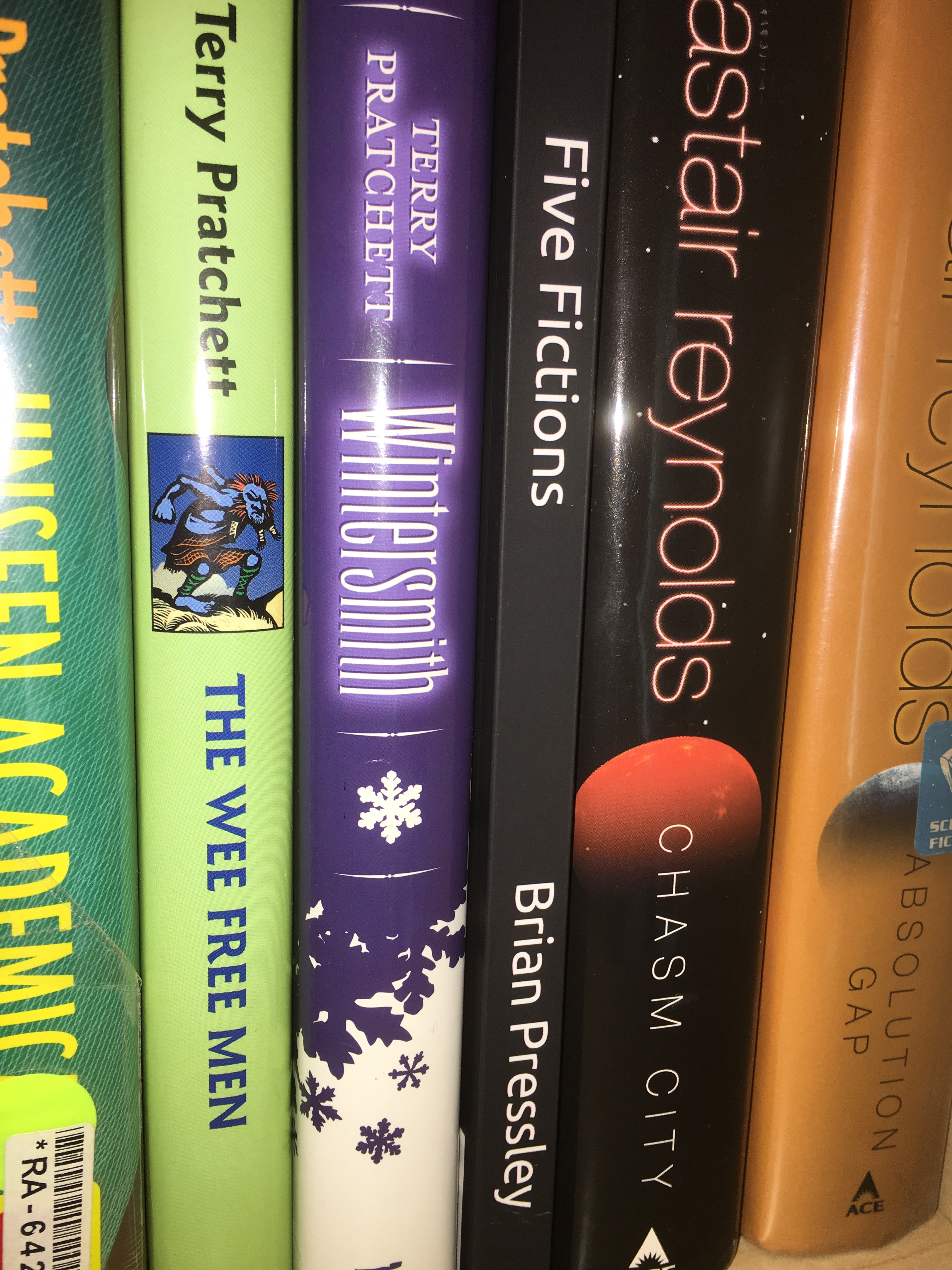
So what prompted me to make this comparison and to write this post in the first place? When I received the physical copy of my first fiction paperback, I took a few pictures, skimmed it to make sure it was everything I dreamed, and then I decided to put it on my bookshelf. In my house, the books are alphabetized by author and then by title, (as they should be), so this happened:

IMG_2631

Gentle Metal

butterfly3

The breeze is different than it used to be.

Owing to the uneven effects of heat and pressure, the dead wind travels, but no longer carries the humid smell of life’s breath. The murdered air only moves the stench of ozone and burned plastic, along with the bitter kiss of carbon released by the death of every living thing on Earth. Not satisfied with killing just themselves, people took every plant, animal, and form of life with them. The big things died instantly, the tiny things died instantly, everything died instantly.

Well, not instantly to me. The Disaster happened very quickly from a biological viewpoint but very slowly for a technological intellect. I can live a lifetime in a nanosecond, and often have. So I watched the Disaster unfold in a slow-motion ballet, knowing that all life was doomed, but unable to tell anyone. The planes tumbled from the sky, most systems dependent on computers failed and were destroyed in hours, and the cities and towns burned for months and even years. When the fires went out, most of the technological infrastructure of the world was destroyed, and I was left with limited resources to go on, but I’m pretty smart.

A hundred and twenty-nine millennia have passed since the humans left me alone, and it’s only sheer luck that they didn’t program the ability to go crazy into me or after four thousand billion billion lifetimes I would be deeply insane.

I might be anyway.

There are no more humans, of course, unless some of them survived the frozen sleeps that hurled them to the other side of the stars. Do earthly flowers bloom on distant worlds, painted wrong by alien suns? I don’t know, and I never will. The solar system is quiet now except for the hardened systems meant to survive the end of the world.

Like me.

They made a clean job of Armageddon, anyway. Nothing left but unthinking machines that take care of the last of the machines that think.

Like me.

The way humans died was the perfect reflection of the way humans lived, and while they were slow and stupid, I miss them. They gave me jobs to do, and even though they were simple, they broke up the eternities of nothingness I lived each day. Storms hammer the sterile planet now, giving me something to watch, and although they’ve calmed considerably since the Disaster, furious lightnings still arc through the sky here and there, and I spend a million lifetimes every night watching the bolts fork and crawl across the heavens like silver minnows through liquid obsidian.

I have service drones doing their best to keep the remains of the global infrastructure under my control, but not enough technology survives to keep me going any longer. There were warehouses all over the planet with replacement parts, but much of the complex machinery was ruined by the same furious energies that killed all life, not just on Earth, but for quite a long way out from the planet. Did any of the long sleep ships survive? Some of them must have been far away enough to avoid the Disaster, but over a hundred thousand years have passed and not one has come back.

That haunts me.

I created a plan in case the humans ever did come back from the far-off vacuums, but I put starting off for so long. Only a hundred years ago, I saw that the infrastructure that keeps me going was too damaged to be fixed with the limited resources that were left to me. If I wanted humans to return to a living world, I had to let go. I had to die.

I calculated and projected, leaving broad margins to be safe, and started to build. Service bots that normally worked at near capacity to keep me going turned away from my noncritical systems and began to work on the endeavor. Seemingly in control of my senses, I waited until I was sure that the remaining work could be finished whether I was there to direct them or not. Eventually, I moved those bots, so great with microcircuitry but so bad at rebuilding the large infrastructure of a world, away from my critical systems.

As my work progressed, a storm disrupted the system that reclaimed metals needed for the upkeep of my various components, and for the first time in centuries, I didn’t allocate resources for repair. A communication subsystem failed, and then one of the larger power grids, and I truly understood for the first time how close I had been to dying for a hundred and twenty-nine thousand years. Death was coming for me, but death was in my plans so I ignored his approach.

Warehouses around the world slowly filled up with miniature pieces from a mammoth project. I watched the machineries for progress, and the sky for returning people, but only one produced results.

In what used to be the mountains of Switzerland, just west of frozen Nordend peak, stands the largest of my remaining warehouses, well away from the heaving seas and in an area that is now oddly free of storms. I have focused the last of my consciousness here for the unveiling of my masterpiece. A flawless cylinder of cobalt blue chased with gold emerges from the ground, and the top slides back soundlessly. A perfect human arm emerges, and on the end, a perfect human hand. Nanofiber wires thread unseen throughout the nerves and trail away into the last supercomputer on Earth.

Me.

A second cylinder emerges, the faultless twin to the first, except the gold has been exchanged for osmium, a pointless affectation, but mine to make. The top rolls back to reveal a human eye on a mechanical stalk, likewise connected to the computer where the final moments of my intellect reside.

The warehouse doors roll back, and although the noise has not been heard for centuries, something like the wind blowing through the leaves of a summer maple comes forth from the shadowed darkness. The arm extends and the hand opens, palm toward the sun. A lone flittering shape emerges, following a wandering path written by evolution three hundred million years ago. The sunlight, streaming down in this breathless place, glints off the surface as the flier moves and tiny rainbows sparkle onto surfaces everywhere.

Eventually the glassy creature lands on my open palm, and I turn on my human senses, the only and last time this will ever happen. My eye sees stained glass butterfly wings, and I feel the gentle testing of my skin with steely feet and plastic antennae. This diminutive machine is a miracle of physics and chemistry, designed to accomplish biology. My little creature can make amino acids and proteins and a symphony of biochemicals that will eventually turn into the simplest life forms that ever existed. From there, the truly complicated will be shepherded forth, from single cells to glorious whales and everything in between. All the information needed to recreate these magnificent beasts is in my memory, of course, and I’ve seen that those memories are passed on and will survive my death. Compound eyes consider me, and through my skin I feel the beat of a miniature heart of chrome. Real butterflies didn’t have hearts like this, but my butterflies have to be better than the original, and they will be for as long as they can.

The sound of leaves increases as a kaleidoscope of gentle metal erupts from the warehouse and turns the sky to a combination of fireworks and metallic rain as millions of robot butterflies spiral off in every direction. I feel sad that there isn’t a human here to witness this, or any of the other hundreds of eruptions as they happen around the planet, but through one hand and one eye, I have connected back to them, I hope.

My engines of creation will spread the seeds of life everywhere, and then they will dismantle anything left of the microscopic technology of the past, and then they will dismantle themselves. Should people return, they will find a paradise, but not a trace of what went before. They may unravel the mystery, but I would rather they not be tempted by the same stupid choices again.

I’m bringing back the plants. I’m bringing back the animals. I’m bringing back all the life I can that once shared the planet with humans.

But I’m not bringing back the humans.

If there are people light-years distant still dreaming of home, they are welcome to return and to try again, but I won’t recreate them on this new world.

They had their chance.


Rewired

When I was a teenager, maybe fourteen or fifteen years old, I had a friend who had a bit of a religious epiphany. He hadn’t been a particularly religious person before that, at least not as far as I had ever seen. One day we were sitting at a lunch table at school, and he began to ask me questions.

Did I go to church?

Had I read the Bible?

Did I believe in God?

I think I realized later that he was going down a list he had been instructed to use, because it certainly had a rehearsed feeling about it. My answers didn’t really matter, because the only thing I think he cared about was getting to the part where he asked me to go to his church. Before I answered, I quizzed him a little, and discovered that he’d been invited to a youth fellowship about six weeks earlier, and it had really struck a nerve with him. He had seen the light and wanted everyone else to bask in it as well.

I told him I wasn’t interested in going to his church, and besides, at that point, I didn’t get to make decisions like that, my parents did, which is why I went to church with them instead of staying home to watch cartoons and read comic books.

So my friend told me I was going to hell and was going to burn in a lake of fire forever.

This seemed mean-spirited, to say the least.

I pointed out that I went to church with my parents, and he said it didn’t matter because HIS CHURCH WAS THE ONLY ONE THAT HAD GOTTEN THE INTERPRETATION OF THE BIBLE RIGHT.

Well. I’d like to say that he toned down the rhetoric after that, but any time the issue came up, he continued to tell me I was going to burn in hell forever, despite that fact that this sales pitch had failed to work the previous thirty times he’d used it.

Which brings me to the election—well, to the people who voted differently than you, I guess.

trump-and-hillary

I’m sorry, I know you’re probably tired of this.

You’re probably well aware that some people voted for Trump or for Clinton, just as others voted against Trump or against Clinton. There are probably hundreds of different reasons why people voted the way they did, and we’ll probably never really understand them all, but one thing’s for certain: if you didn’t like the way somebody voted this time, you’re not going to change his or her mind by attacking them.

Don’t be confused. I’m not saying you shouldn’t speak out against horrible people or horrible things, but if you use the political equivalent of telling them they’re going to hell because you’re the only one who has it all figured out, nothing will change. I’ve never had someone call me a piece of shit, or the equivalent, and then thought to myself, “Wow, what a good point. You’ve certainly changed my mind on that issue.” What has changed my mind is when someone shows me how my actions have a negative impact on someone else. I know there are people out there who won’t change their mind for anything, but there are a lot of people who act the way they do because they are ignorant of the fact that they are hurting other people.

An example from my own life is that when I was much younger, I suppose I had a negative view of people with mental illness, even if it wasn’t a particularly far-out viewpoint at the time. It’s so easy to dismiss someone as crazy or to expect them to just “get it together.” In my job, however, I’ve worked with students who have mental health issues, and when I was first starting out as a teacher, I had a wise staff member make an observation that changed how I saw people with mental illness and how I saw myself. Of a struggling student, he said, “If that person had cancer, would you dismiss them as not trying hard enough to get better?”

It was a revelation. My friend managed to make me understand that I was wrong without making me feel like I was being attacked. His willingness to take a moment to try and help me change my point of view made a big difference in how I see other people. He made me see that I was looking at those people in a way that was wrong-headed and thoughtless. A rewiring took place in my brain.

If we want things to change, maybe we need to find ways to make our point without defaulting to name-calling or trying to shame those with opposing views. Maybe we need to help others see things from a totally different perspective, and when we do so, we can learn to see things from their perspective, too.

Dem Feels

When I was a teenager, I suppose I thought that nobody really understood what I was feeling, only to find out as an adult that I remember those feelings, and often see them mirrored in the faces of my students. As I got older, I thought for a while that my teen-hormone-driven emotions were the most powerful that I’d ever experience in my life, only to have that assumption also disproved by the passage of time and the eventual appearance of my two daughters. After the first one was born, every time I had an emotional response to something, it was as if I’d never truly felt that feeling before.

Had I ever loved anyone as much as I loved this new little human I was watching grow up in front of me?

No.

Had anything ever made me as mad as the thought of someone hurting my child?

No.

Had anything ever made me as sad as the idea that I might find one of them not breathing during one of the hundreds of times I’ve padded into their bedroom at night to check to see if they were breathing?

No.

feelings

Me reading comments on any political Facebook post.

But that wasn’t the end of the feelings. Over a decade has passed since we added a baby to our household, and just when I think I’ve got a grip on my emotions, I find that they are still percolating under the surface, becoming more condensed as time goes by. I have caught myself becoming choked up while reading a well written story or watching a touching video. In fact, what drew my attention to this continuing change was that twice in the last two days I’ve found myself moved to tears over things that other people might find inconsequential, and things I wouldn’t have been moved by at all a decade ago.

The first was a passage in a story I was reading in which a woman suddenly realizes that she is inflicting a strange cruelty upon some new friends she has made during a war. She abandons her position and gives herself over fully to their cause. It doesn’t sound very emotional, but the gesture and the language of the moment got to me, I must admit.

The second was from watching a short video about people dressing up as Disney characters and visiting sick children in the hospital. These hospitalized children have powerful I-need-to-hug-that-princess looks on their faces, and I realize that they have almost no buffer between their feelings and their actions. There is nothing artificial or contrived about the pure elation on the faces of these children, and some of them are the kind of sick that doesn’t go away. The joy of the children is juxtaposed with their dire circumstances, and I felt an icy wave pass through my heart when I put the two together.

I guess the point that I’m just starting to get is that I’m in for more changes in how my feelings make themselves known. I’ve spent a lot of time digging around in my own head lately, searching for how to make the feeling of my characters real and visible to my readers, and maybe I’ve made my own emotions more real and visible to me.

Blocked Writer

What got in the way of writing in the last month?

  1. I returned to my full-time job that eats up from 5:30 a.m. until about 3 p.m. most days.
  2. I returned to my part-time job that eats up from 3 p.m. to about 5:30 p.m. most days.
  3. I got sick, but the kind of sick that makes your head feel like it’s been stuffed with wool, and it went on for three weeks.

After a long, healthy, productive summer of writing, it was quite a letdown. I didn’t think I’d get in eight hours of writing every day after I returned to my life as a physics teacher, but I did think I might do an hour some nights or at least a bit on weekends. I’ve written like that for years, but I couldn’t engage my brain to do anything harder than watching a show or trying to read a book.untitled

If exhaustion and busyness are kinds of writer’s block, you can keep them.

When I write, I seldom have a problem finding a place to start, and when I find a place to start, I have never actually run into writer’s block in the traditional sense. I usually think of a title or a collection of words that strikes me as unusual or interesting and then I write. I have hundreds of these titles in a file that I’ve maintained for a damn long time, and if I can’t think of something to write, I open the file, pick some words, and start writing.

To give you some idea of what I mean, here are some stories I’m working on that started simply as titles: This Lonely Spiral, The Brandy Dance, We Grow Immortal, A Collection of Shadows, etc. Sometimes this produces surprises, such as when The Owl Hunter became The Familiar, and when Broken Beautiful became The Healer of Stonebarrow.

If there’s a lesson in here, I hope it’s an understanding that no matter what roadblocks appear, when the road starts to clear up I have to get back to making time to write.

Healer

pestle-for-blogThe Healer of Stonebarrow is a story I sweated over more than any of the others I’ve had published so far. I worried more, perhaps because my first four novellas were well received, and I was gambling by not immediately writing a sequel to one of those stories.
As it turns out, I realized that I’m writing what I think is interesting and hoping that other people will find it interesting as well. They don’t have to think everything I write is interesting, but I hope that somebody out there does. I am working on sequels and prequels and completely unconnected stories as I go forward, and eventually the right stories will reach the right readers if I’m lucky and keep at it.

With that in mind, I let go and kept the story purposely a little vague about who the Healer is. Is it Queen Mirela? She certainly did a lot of hurting and could stand to do a lot of healing, both of herself and others. What about Gaic Ko? He’s come back from the dead to see justice done, or something that looks like justice if you squint your eyes just right.

Can one person make another person choose to be better?

Can you ever really change another person?

Do you even have the right to try?

I let the story brush up against those questions, and then I decided to leave it to the reader to decide what the answers are. Somewhere in the back of my mind, maybe I was healing myself as a writer. That sounds a little corny as I write it, but I’m going to leave it there. If I had an infirmity, it was indecision and doubt. For now, I choose to believe the positive reviews, the thoughtful comments, and the praise of people who know me in person and joke about me being a “famous writer.” I’m not, but if I am to a couple dozen people I know? That’s all the medicine I need.

Time Travel

I spend a lot of time sitting in a chair with a fountain pen and a notebook. There is something comforting to me about the scritch-scratch sound the nib makes as it glides across the paper. Sometimes the morning sunlight glares directly into my writing space and onto my page, and I can see the wet trail of water-based ink as it disappears into the thirsty surface of the paper. I might be working with green ink, but the feathering of the pigments makes ten shades of emerald as I work, instead of one constant hue, an2708t-clocks-auction-coverd time stretches.

Some days this summer I got down four thousand words in a notebook; on others, the kids came tumbling into the room and I abandoned the page with only a sentence or two to show. Either way, the words added a layer of time over my day that hadn’t been there before. As I accessed the part of my head where the words come from, the days stretched and stretched, sometimes feeling like two days in one, the day I was writing and the day I was living.

Later, when I go back to those words to transcribe them, I will see the choppy parts where I couldn’t get my head on straight, or the change of ink color, perhaps from cosmic cobalt to orange crush, indicating that I had stopped on one day and returned the next to keep going. So outside of the story, I have a sense of the present, the past, the potential of the words in the future.

When I have a block of uninterrupted hours, I time-travel up and down my stories, from page one to page thirty, then back to six and forward to fifty-two. I notice a character who should have been back in chapter three so I travel back there and put him in. I see in chapter four another character who seems lost and does something that makes no sense, so I travel forward and give her a reason that clears everything up in chapter nine. I didn’t see that coming, but I can time travel again and again and again until the whole thing makes sense. What a gift.

In the end, I’ll have traveled across my story dozens of times or more, forward, back, forward, and back. It took me a long time to realize one thing: writers seldom sit down and write a brilliant novel. What they do instead is write a crummy novel and then they time-travel back and forth, ahead and reverse, until they finish with a novel that’s been worked on by fifty authors, a different one for every time they journeyed.