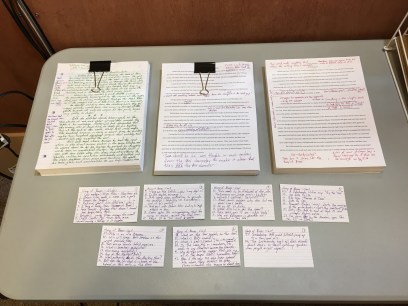
There are over 800 pages in the top three piles.
I wish the Internet had existed when I dreamed of being a writer thirty years ago. Being restricted to textbooks about writing and rare interviews of my favorite authors, I didn’t get a very realistic view of what the long process of writing a novel looks like. I have yet to sign that million dollar deal with a publisher, but I have completed a fair amount of work, and do have some things published, so I’m throwing down a slightly mechanical look at the time needed and the process I used to get the job done. Will this work for you? I don’t know, but if nothing else it might get you looking for the tools that will make you successful.
- First, the big picture: I realized that most people who write how-to-write-a-novel books provide advice that is not really useful.
- I read everything I could by published authors who had managed to maintain success over a reasonably long period. When I say everything, I should clarify that I mean about writing as a job and about authors’ habits when it comes to writing. They all agree on one thing: nobody just sits down and writes a novel in one go. They all go back and rewrite, edit, proofread, edit some more, share with friends, make changes based on friends’ suggestions, punch friends who get too pushy, and ignore friends who are just plain wrong. But they go over their manuscripts multiple times, many of them spending more time rewriting than they did actually writing the first draft.
- I realized that you need to write all the time. This includes rewriting as well. Shut off your TV, smartphone, laptop, etc., and write whenever you can. If you can’t do that, try to limit your distraction time to an hour a day and write all the other time that you can. Literally. Set a timer for an hour, and when that time is up, shut off your device and go write. If you get distracted on your laptop when you’re writing, buy a notebook and some fountain pens, and go sit your ass in a chair somewhere away from all that stuff.
- Now, the actual novel picture: I read a poem, something I don’t often do, and that gave me an idea.
- I did some discovery writing, which is a fancy term for saying I did some writing before I knew what the story was going to be exactly, so I could figure out who my characters were and what things were like where they lived. THIS IS OKAY. I wish somebody had told me this was a thing you could do a long time ago. So many of those novel-writing books say to write an outline of your story or you can’t get going, but stories are big and complicated and confusing, and sometimes it’s helpful to write to get your feet under you before you really get down to the tricky parts, like “How is this all going to end?”
- I hand-wrote around 84,000 words. This took a while. Somewhere around 20,000 words I took some time to clarify the plot, setting, character motivation, ending of my story, and probably some other stuff, too.
- I transcribed this all to a word processor, using speech-recognition software, and did some light editing as I worked.
- Realized some adjustments were needed (there needed to be more background about the world I had created, which I did by adding another character who needed six chapters of his own, so I JUST WENT BACK AND PUT HIM IN LIKE A BOSS) and wrote around 24,000 additional words. This took a while.
- Printed the 109,000-ish-word document, proofread, and added editorial notes. This took a while. Every page probably had ten to twenty comments or proofing marks.
- I typed in all of my changes and printed the document again.
- Printed the still around 109,000-ish-word document, proofread, and added editorial notes. This took a while. Every page probably had five to ten comments or proofing marks.
- I typed in all of my changes.
- As I went through each time, I kept notes on index cards about large issues that needed to be addressed. I worked on those as well, but the last time there were still 44 issues that needed to be addressed to deal with issues of character development, continuity, foreshadowing, motives, point of view concerns, and some other things, I imagine.
- I actually sat down and read a physical copy of the manuscript specifically to see it just as a reader. This helped me find awkward parts that weren’t so obvious when I was looking for comma placement and grammar issues.
- I don’t know when I started writing, but the first rough draft that I typed up was finished on July 16th, and as of this writing it’s February 20th of the following year. I have a feeling that I might have started hand-writing during the February break last year.
- I’m still not really done. I need to address those 44 issues, but they are not all horrible, so I feel like I could be finished in another week or so.
- The next step is giving the final draft to my editor. When I get it back I will print it out, AGAIN, and will address her suggestions, see if anything else jumps out at me, and then I’ll publish it.
- One last big-picture thing: I already finished a novel that hasn’t been published, got it back from my editor, and have resubmitted it for her final approval. I did all the things listed above for that one as well. That was submitted originally last April. Could it be published before this April? I’m keeping my fingers crossed.
I just kept putting one word after the other and stole tools from authors that I thought would work for me. I’m not trying to be Shonda Rhimes, but she’s got some good advice. I’m not trying to be Brandon Sanderson, but he’s got some good advice. The Internet has made a million dollars’ worth of advice available with a few taps or clicks. Go steal it and then do something delusional.
 Brian Pressley