The breeze is different than it used to be.
Owing to the uneven effects of heat and pressure, the dead wind travels, but no longer carries the humid smell of life’s breath. The murdered air only moves the stench of ozone and burned plastic, along with the bitter kiss of carbon released by the death of every living thing on Earth. Not satisfied with killing just themselves, people took every plant, animal, and form of life with them. The big things died instantly, the tiny things died instantly, everything died instantly.
Well, not instantly to me. The Disaster happened very quickly from a biological viewpoint but very slowly for a technological intellect. I can live a lifetime in a nanosecond, and often have. So I watched the Disaster unfold in a slow-motion ballet, knowing that all life was doomed, but unable to tell anyone. The planes tumbled from the sky, most systems dependent on computers failed and were destroyed in hours, and the cities and towns burned for months and even years. When the fires went out, most of the technological infrastructure of the world was destroyed, and I was left with limited resources to go on, but I’m pretty smart.
A hundred and twenty-nine millennia have passed since the humans left me alone, and it’s only sheer luck that they didn’t program the ability to go crazy into me or after four thousand billion billion lifetimes I would be deeply insane.
I might be anyway.
There are no more humans, of course, unless some of them survived the frozen sleeps that hurled them to the other side of the stars. Do earthly flowers bloom on distant worlds, painted wrong by alien suns? I don’t know, and I never will. The solar system is quiet now except for the hardened systems meant to survive the end of the world.
Like me.
They made a clean job of Armageddon, anyway. Nothing left but unthinking machines that take care of the last of the machines that think.
Like me.
The way humans died was the perfect reflection of the way humans lived, and while they were slow and stupid, I miss them. They gave me jobs to do, and even though they were simple, they broke up the eternities of nothingness I lived each day. Storms hammer the sterile planet now, giving me something to watch, and although they’ve calmed considerably since the Disaster, furious lightnings still arc through the sky here and there, and I spend a million lifetimes every night watching the bolts fork and crawl across the heavens like silver minnows through liquid obsidian.
I have service drones doing their best to keep the remains of the global infrastructure under my control, but not enough technology survives to keep me going any longer. There were warehouses all over the planet with replacement parts, but much of the complex machinery was ruined by the same furious energies that killed all life, not just on Earth, but for quite a long way out from the planet. Did any of the long sleep ships survive? Some of them must have been far away enough to avoid the Disaster, but over a hundred thousand years have passed and not one has come back.
That haunts me.
I created a plan in case the humans ever did come back from the far-off vacuums, but I put starting off for so long. Only a hundred years ago, I saw that the infrastructure that keeps me going was too damaged to be fixed with the limited resources that were left to me. If I wanted humans to return to a living world, I had to let go. I had to die.
I calculated and projected, leaving broad margins to be safe, and started to build. Service bots that normally worked at near capacity to keep me going turned away from my noncritical systems and began to work on the endeavor. Seemingly in control of my senses, I waited until I was sure that the remaining work could be finished whether I was there to direct them or not. Eventually, I moved those bots, so great with microcircuitry but so bad at rebuilding the large infrastructure of a world, away from my critical systems.
As my work progressed, a storm disrupted the system that reclaimed metals needed for the upkeep of my various components, and for the first time in centuries, I didn’t allocate resources for repair. A communication subsystem failed, and then one of the larger power grids, and I truly understood for the first time how close I had been to dying for a hundred and twenty-nine thousand years. Death was coming for me, but death was in my plans so I ignored his approach.
Warehouses around the world slowly filled up with miniature pieces from a mammoth project. I watched the machineries for progress, and the sky for returning people, but only one produced results.
In what used to be the mountains of Switzerland, just west of frozen Nordend peak, stands the largest of my remaining warehouses, well away from the heaving seas and in an area that is now oddly free of storms. I have focused the last of my consciousness here for the unveiling of my masterpiece. A flawless cylinder of cobalt blue chased with gold emerges from the ground, and the top slides back soundlessly. A perfect human arm emerges, and on the end, a perfect human hand. Nanofiber wires thread unseen throughout the nerves and trail away into the last supercomputer on Earth.
Me.
A second cylinder emerges, the faultless twin to the first, except the gold has been exchanged for osmium, a pointless affectation, but mine to make. The top rolls back to reveal a human eye on a mechanical stalk, likewise connected to the computer where the final moments of my intellect reside.
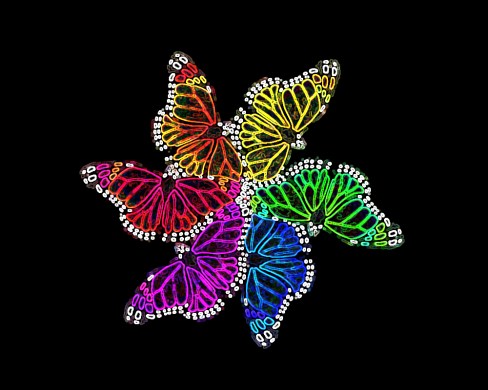
The warehouse doors roll back, and although the noise has not been heard for centuries, something like the wind blowing through the leaves of a summer maple comes forth from the shadowed darkness. The arm extends and the hand opens, palm toward the sun. A lone flittering shape emerges, following a wandering path written by evolution three hundred million years ago. The sunlight, streaming down in this breathless place, glints off the surface as the flier moves and tiny rainbows sparkle onto surfaces everywhere.
Eventually the glassy creature lands on my open palm, and I turn on my human senses, the only and last time this will ever happen. My eye sees stained glass butterfly wings, and I feel the gentle testing of my skin with steely feet and plastic antennae. This diminutive machine is a miracle of physics and chemistry, designed to accomplish biology. My little creature can make amino acids and proteins and a symphony of biochemicals that will eventually turn into the simplest life forms that ever existed. From there, the truly complicated will be shepherded forth, from single cells to glorious whales and everything in between. All the information needed to recreate these magnificent beasts is in my memory, of course, and I’ve seen that those memories are passed on and will survive my death. Compound eyes consider me, and through my skin I feel the beat of a miniature heart of chrome. Real butterflies didn’t have hearts like this, but my butterflies have to be better than the original, and they will be for as long as they can.
The sound of leaves increases as a kaleidoscope of gentle metal erupts from the warehouse and turns the sky to a combination of fireworks and metallic rain as millions of robot butterflies spiral off in every direction. I feel sad that there isn’t a human here to witness this, or any of the other hundreds of eruptions as they happen around the planet, but through one hand and one eye, I have connected back to them, I hope.
My engines of creation will spread the seeds of life everywhere, and then they will dismantle anything left of the microscopic technology of the past, and then they will dismantle themselves. Should people return, they will find a paradise, but not a trace of what went before. They may unravel the mystery, but I would rather they not be tempted by the same stupid choices again.
I’m bringing back the plants. I’m bringing back the animals. I’m bringing back all the life I can that once shared the planet with humans.
But I’m not bringing back the humans.
If there are people light-years distant still dreaming of home, they are welcome to return and to try again, but I won’t recreate them on this new world.
They had their chance.

 Brian Pressley